

Featured Solutions and Suppliers
Interested in a solution? Click "View Supplier" to learn more about the supplier.








-1.png)


.png)


How Flexible Packaging Films Are Built and Why It Matters
Understanding why flexible packaging is difficult to make sustainable requires understanding how conventional flexible films are actually constructed. Most brands and even most marketing teams do not know this, and it explains almost everything about the recyclability problem.
Conventional flexible packaging uses multilayer laminate structures that bond several distinct materials together into a single film. A typical snack bag might combine a PET outer layer for stiffness and print surface, an aluminum foil middle layer for oxygen and moisture barrier, and a polyethylene inner layer for heat sealability and food contact. These layers are bonded with adhesives and sometimes include additional barrier layers like EVOH or nylon. The result is a package with excellent barrier performance, long shelf life, and low weight. The problem is that mechanical recycling systems cannot separate these bonded layers. Near-infrared sorting equipment at materials recovery facilities reads only the outer layer, typically PET, which contaminates PET recycling bales when the rest of the laminate structure is present. Most conventional flexible pouches end up in landfill regardless of what the packaging claims.
This is not a minor inefficiency. Flexible packaging represents a significant share of all plastic packaging waste globally, and recycling rates sit below 10 percent in the United States and around 12 percent in the EU. The recycling problem is structural, not a matter of consumer behavior. Telling consumers to recycle flexible packaging that the infrastructure cannot process is greenwashing regardless of intent.
The three material approaches that the industry is pursuing to address this are mono-material films, compostable films, and paper-based flexible packaging. Each involves genuine trade-offs that are worth understanding before evaluating suppliers.
The Three Sustainable Film Directions: What Each One Actually Delivers
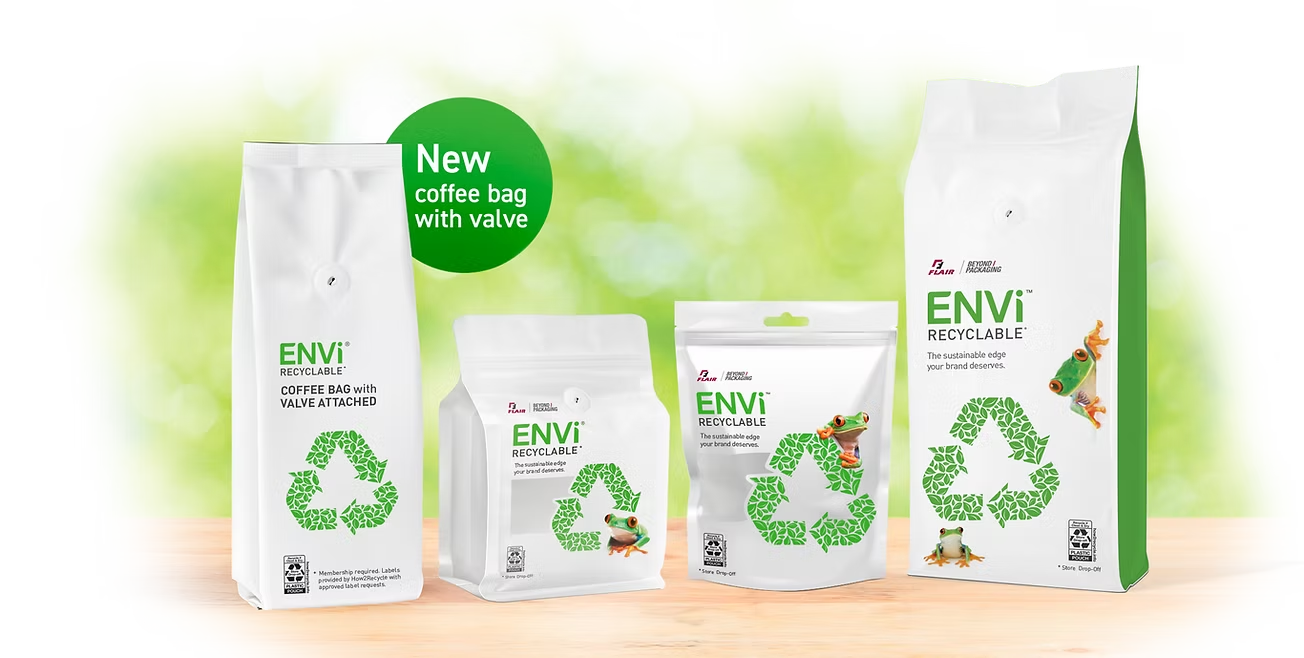
Mono-material films are the dominant transition pathway, representing roughly 65 percent of sustainable flexible packaging volume in the market today. The concept is straightforward: replace the multilayer laminate with a single polymer family, typically all-polyethylene (all-PE) or all-polypropylene (all-PP), so the complete film structure can be recycled in flexible film streams. All-PE pouches are compatible with store drop-off flexible film recycling programs in the United States under How2Recycle designation and with curbside programs in some international markets. This is a genuine recyclability improvement over conventional multilayer laminates.
The trade-off is barrier performance. Conventional foil laminates achieve oxygen transmission rates below 2 cubic centimeters per square meter per day and moisture vapor transmission rates below 1 gram per square meter per day, enabling 24-month shelf life for sensitive products. All-PE structures typically achieve OTR of 8 to 15 cubic centimeters and WVTR of 3 to 5 grams, which supports 18-month shelf life for most dry and semi-sensitive applications. This is a meaningful but not catastrophic performance gap for many products. Advances including biaxially oriented PE (BOPE), machine-direction oriented PE (MDO-PE), and silicon oxide metallization coatings are progressively narrowing the gap. Mars Petcare has validated all-PE kibble bags at commercial scale of over 80 million pouches annually with 18-month shelf life and How2Recycle full body number 2 designation, which is currently the most significant commercial proof point for this transition. All-PP films achieve similar recyclability in number 5 streams where that infrastructure exists, though number 5 acceptance in U.S. curbside programs remains limited compared to number 2.
Compostable flexible films made from PLA and PBAT blends, PHA, starch-based polymers, and cellulose films address the recyclability problem through a different pathway: designing the film to break down in composting environments rather than recycling streams. The honest assessment of where this stands today is that it works well in specific applications and has significant infrastructure constraints that affect the real-world validity of compostability claims. PLA and PBAT blends are certified to ASTM D6400 for industrial composting and achieve adequate barrier performance for dry goods and short shelf life applications, but require commercial composting facilities operating at 58 degrees Celsius and above to break down, and less than 5 percent of home composting attempts with PLA achieve meaningful breakdown. PHA films are certified home and marine compostable and maintain barrier performance across a wide temperature range including frozen applications, making them the technically strongest compostable film option, at a cost premium of roughly two to three times PLA. Cellulose-based films are genuinely home compostable and work well for dry goods overwraps and sachets. The infrastructure gap between what certifications guarantee under controlled conditions and what actually happens when consumers dispose of compostable packaging in real waste streams remains the honest limitation of this approach in most U.S. markets.
Paper-based flexible packaging combines kraft or specialty paper substrates with barrier coatings to create flexible packaging structures that dramatically reduce plastic content. Water-based dispersion coatings, bio-based extrusion coatings, and emerging nanocellulose barrier coatings are making it possible to achieve grease and moisture resistance adequate for coffee, snacks, and dry foods on paper substrates that are recyclable in paper streams when the coating is compatible with paper mill repulping processes. Paper-based flexible pouches and flat-bottom bags reduce plastic content by 70 to 80 percent compared to conventional laminates and can run on standard filling equipment without significant retooling. The coating question is the critical variable: water-based and bio-based coatings compatible with paper recycling are the preferred specification, and heavy polymer coatings that behave like plastic in recycling systems undermine the paper recyclability story despite the fiber substrate. Nanocellulose barrier coatings achieving OTR below 10 cubic centimeters are in commercial pilot with major paper packaging manufacturers and represent the most significant near-term development in this space.
Chemical recycling is a fourth pathway that processes mixed flexible film waste including conventional multilayer laminates through pyrolysis or chemical depolymerization back into monomers or naphtha that can become new packaging material. This technology exists at commercial scale and addresses legacy multilayer film waste that mechanical recycling cannot handle. It currently processes roughly 2 percent of flexible film volume in the U.S. and runs at significantly higher cost than mechanical recycling. Chemical recycling is a meaningful part of the long-term solution for the existing flexible packaging waste stream but should not be presented as a current alternative to designing recyclable or compostable formats into new packaging.
How to Choose Sustainable Flexible Packaging Suppliers
Flexible packaging film supplier selection requires matching your product's barrier requirements to the material's actual performance before any sustainability conversation is meaningful, because a recyclable film that cannot protect your product through its shelf life solves nothing.
Using the 5 P's as a frame: Price for mono-material PE films runs roughly 10 to 15 percent above conventional multilayer laminates at comparable volumes, a gap that has been narrowing as volume scales. Compostable PLA and PBAT films run 30 to 40 percent above conventional. PHA films run significantly higher. Paper-based flexible structures run 20 to 25 percent above conventional. EPR programs in Colorado, Maine, Oregon, and other states are changing this comparison: multilayer non-recyclable films face per-ton fees that can run hundreds of dollars per ton, while recyclable mono-material films face significantly lower fees, shifting the total cost of ownership calculation meaningfully toward sustainable formats at scale. Performance means OTR and WVTR validation at your specific product type and target shelf life under real storage conditions, machinery compatibility confirmation with your existing vertical or horizontal form-fill-seal equipment before volume commitment, and How2Recycle certification for any recyclability claims covering the complete assembled package including zipper, spout, and inks. Preference reflects your channel and brand positioning: natural and premium brands with engaged consumers can support stronger end-of-life claims while mass market programs have more flexibility on certification specifics. Proof covers How2Recycle certification for recyclable film claims, BPI or TÜV OK Compost Home certification for compostable claims on the complete assembled structure, FSC certification for paper-based formats, and PCR content verification through GRS or ISCC for any recycled content claims. Partner quality means a supplier with barrier validation data for your specific product category rather than general film specifications, and experience running their material on the filling equipment format you use.
Ask suppliers for OTR and WVTR data at your storage conditions rather than ambient temperature specifications. Ask for How2Recycle certification documentation on the complete assembled package. Ask whether their film has been validated on equipment comparable to your filling line before committing to a trial run.
Why can't most flexible packaging be recycled?
