

Featured Solutions and Suppliers
Interested in a solution? Click "View Supplier" to learn more about the supplier.




Sustainable Foodservice Packaging Formats and the Materials Behind Them
Foodservice packaging covers more distinct format categories than almost any other packaging sector, and the right material decision for each format depends on the food type, heating requirements, end-of-life infrastructure, and the specific regulations active in the markets where you operate.
Takeout containers and clamshells are the highest-volume format in most restaurant operations and the category most directly affected by EPS foam bans. Expanded polystyrene foam clamshells have faced active restrictions in a growing number of U.S. states including California, New York, Virginia, Oregon, Rhode Island, and Delaware, with more states moving through legislation. The primary sustainable replacement is bagasse clamshells made from sugarcane fiber, which offer foam-like rigidity, heat tolerance up to around 200 degrees Fahrenheit, grease resistance adequate for most hot food applications, and industrial compostability certification under ASTM D6400. Molded pulp clamshells made from recycled paper fiber follow the same end-of-life pathway. Mineral-filled polypropylene (MFPP) containers are the most practical recyclable alternative where composting infrastructure is limited, using calcium carbonate fillers to reduce plastic content while maintaining a white stackable format that recycles as PP. Full detail on compostable clamshell materials and suppliers is on the Compostable Clamshell Containers page.
Coffee cups and hot beverage packaging present a specific challenge because the PE lining that makes most paper cups liquid-resistant also makes them non-recyclable in standard paper streams. Aqueous barrier coatings and bio-based coatings applied to kraft paperboard are replacing PE lining in current sustainable cup specifications, maintaining liquid resistance while enabling recyclability or compostability depending on the coating type. PLA-lined paper cups are industrially compostable but require commercial composting infrastructure for proper end-of-life and should not be marketed as recyclable. Recycled paperboard cups with PCR content and water-based coatings are the most broadly compliant option across markets. Lids made from rPET are recyclable where rigid PET is accepted, while molded fiber lids are compostable. Full detail on sustainable coffee cup materials is on the Compostable Coffee Cups page.
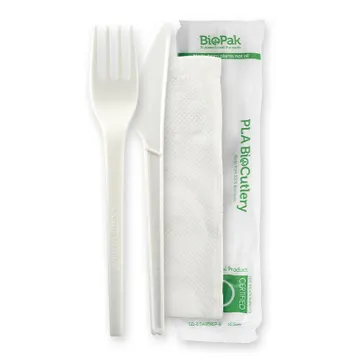
Disposable cutlery is subject to plastic restrictions in several U.S. states and EU member countries that require plastic cutlery to be provided only on customer request or ban it outright. CPLA (crystallized polylactic acid) is the dominant compostable cutlery material for hot food applications, handling temperatures up to around 185 degrees Fahrenheit and certified for industrial composting. Wood and bamboo cutlery are home compostable and work well for cold and room temperature applications. PHA cutlery is the most technically advanced option, home and marine compostable and heat-tolerant above 200 degrees Fahrenheit, at a higher per-unit cost than CPLA or wood. Full detail on compostable cutlery materials and certifications is on the Compostable Utensils and Cutlery page.
Paper takeout boxes in kraft paperboard or molded fiber formats have largely replaced foam containers for burger, sandwich, and hot entree applications in markets with EPS bans. The key sustainability variable in paper takeout boxes is the coating: water-based and bio-based coatings maintain paper recyclability while PE lamination creates mixed-material structures that most paper recycling systems cannot process. Full detail on paper takeout box materials is on the Paper Takeout Boxes page.
Drink carriers made from molded fiber or kraft paperboard are among the most straightforward sustainable transitions in foodservice since fiber-based carriers are already the dominant format and are widely recyclable in paper streams. Full detail is on the Recyclable Drink Carriers page.
Straws have been subject to request-only laws in several states including California, Washington, Colorado, and Delaware, with plastic straw bans driving adoption of paper straws, PHA straws, and bamboo straws. Paper straws with aqueous coatings perform well for most cold beverage applications and hot liquids up to around 200 degrees Fahrenheit without the sogginess problems that affected earlier paper straw generations. PHA straws are the strongest performing sustainable straw option, home and marine compostable and heat-tolerant, at a cost premium over paper.
PFAS and Regulatory Compliance in Foodservice Packaging
PFAS regulations are the compliance issue most foodservice operators are underprepared for, because the chemicals were historically used in the grease-resistant coatings applied to pizza boxes, takeout containers, paper wraps, and bakery liners without being prominently disclosed.
More than ten U.S. states have enacted enforceable bans on intentionally added PFAS in food packaging, with California, Maine (effective May 2026), Illinois, Oregon, Washington, Minnesota, and others among the states with active requirements. Maine's May 2026 deadline is the hardest current enforcement target for foodservice operators, applying to plant-fiber food packaging including paperboard, pizza boxes, and takeout trays with a 100 ppm total organic fluorine threshold. The EU has enacted even stricter thresholds under Regulation 2025/40 effective August 2026, setting limits as low as 25 parts per billion for individual PFAS compounds in all food packaging.
The highest-risk foodservice items where PFAS coatings have historically been most common are pizza boxes, takeout clamshells, paper sandwich wraps and fry liners, and food trays. The practical compliance path is requesting PFAS-free certificates of compliance from all paper and paperboard suppliers rather than relying on general marketing language, since PFAS-free is not a regulated term and documentation requirements vary by state. Bagasse and molded fiber containers are inherently PFAS-free and represent a straightforward compliance path for operators converting away from coated paper formats. Uncoated kraft, aqueous-barrier kraft, and water-based dispersion-coated papers are the paper-based PFAS-free alternatives for wraps and liners.
How Foodservice Operators Choose Sustainable Packaging
Sustainable foodservice packaging selection involves balancing performance, regulatory compliance, end-of-life claims, and supply reliability in ways that affect daily operations if any element fails.
Using the 5 P's as a frame: Price for sustainable foodservice packaging carries premiums that range from minimal (kraft paper boxes versus foam at volume) to meaningful (PHA cutlery versus polystyrene). The regulatory cost calculus is shifting that comparison: EPS foam bans carry fines of up to five thousand dollars per violation in some jurisdictions, EPR programs are beginning to assign per-ton fees to non-recyclable packaging, and PFAS violations carry similar penalty exposure. Total cost of ownership including compliance risk is the accurate comparison, not unit cost alone. Performance means heat tolerance, grease resistance, and structural integrity for your specific menu, with hot and saucy foods requiring different material specifications than cold grab-and-go applications. The broadest compliant combination for most operators is bagasse or molded fiber containers for hot entrees, kraft or aqueous-lined paper cups for hot beverages, CPLA or wood cutlery, and kraft paper takeout boxes, which covers the vast majority of use cases across all current U.S. ban jurisdictions simultaneously. Preference reflects your service model: full-service catering, quick service, campus dining, and delivery programs have different format requirements and composting program access that should drive material choices. Proof covers PFAS-free certificates of compliance for all paperboard and paper formats, compostability certification to ASTM D6400 for any industrially compostable claims, and BPI or TÜV OK Compost Home for home compostable claims where relevant. Partner quality means reliable stock in the formats and quantities your operation requires, since foodservice packaging is a daily operational consumable where supply gaps create immediate service problems.
Ask suppliers for PFAS-free certificates of compliance for all paperboard and paper-based formats before making any purchasing commitment. Ask whether compostability certification covers the full assembled container including any coatings, inks, and closures. Ask specifically which states their products are compliant in if you operate across multiple jurisdictions.
