

Featured Solutions and Suppliers
Interested in a solution? Click "View Supplier" to learn more about the supplier.


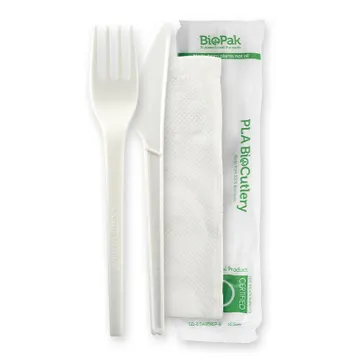
Compostable Cutlery Materials: What Each One Actually Is
The compostable cutlery category covers five distinct material families that perform differently across heat tolerance, strength, aesthetics, and end-of-life pathway. Choosing the wrong material for your food type or service model creates performance problems that erode any sustainability benefit.
CPLA (crystallized polylactic acid) is the dominant material in commercial compostable cutlery. It is derived from corn or sugarcane starch and processed through a crystallization step that improves heat resistance significantly over standard PLA, typically tolerating temperatures up to around 185 degrees Fahrenheit. This makes CPLA the appropriate choice for hot food applications including pasta, soups, and entrees where standard PLA would soften and deform. CPLA has a smooth finish that closely resembles conventional plastic cutlery, which is why it is the default for most restaurant and catering programs transitioning away from polystyrene. It is certified compostable under ASTM D6400 and EN 13432 for industrial composting, breaking down in commercial facilities in roughly 90 to 180 days. Home composting is not the appropriate end-of-life pathway for CPLA and claiming otherwise creates greenwashing risk.
Standard PLA cutlery (not crystallized) is a lower-cost alternative that works for cold and room-temperature applications but softens well below CPLA's threshold. It is best suited for cold grab-and-go programs, salads, and cold desserts where heat is not a factor. The cost difference between PLA and CPLA is meaningful at volume, so matching material to application rather than defaulting to one across all formats is worth the specification effort.
PHA (polyhydroxyalkanoates) is the most technically advanced bioplastic in the compostable cutlery category and the one generating the most interest among brands making premium sustainability claims. PHA is produced through microbial fermentation of plant-based feedstocks including canola, soy byproducts, and sugarcane, and its environmental profile is meaningfully stronger than PLA and CPLA in several respects. PHA cutlery handles hot foods at temperatures comparable to CPLA, delivers higher mechanical strength that resists snapping on tough foods, and critically breaks down in home composting, soil, and marine environments rather than requiring industrial composting infrastructure. This makes PHA the only compostable cutlery material that can genuinely support a home compostable claim backed by certification standards including TÜV OK Compost Home. The trade-off is cost: PHA cutlery typically runs two to three times the per-unit cost of CPLA at comparable volumes, though high-volume contracts and blended PHA and PLA formulations (which use 20 to 30 percent PHA to improve performance at lower cost) are bringing the economics closer. For brands in markets pushing beyond industrial-only certification requirements or making strong environmental positioning claims, PHA is worth serious evaluation.
Wooden cutlery made from FSC-certified birch, aspen, or bamboo is the most accessible home compostable option at mainstream price points. Wood utensils are naturally rigid and heat tolerant, suitable for a wider range of food temperatures than standard PLA, and compostable with yard waste in most backyard composting environments without certification complexity. The aesthetic is distinct from plastic, which works well for premium positioning, farmers markets, and event catering but may not align with every brand's presentation expectations.
Bagasse and wheat straw fiber utensils are molded from agricultural byproducts and offer heat tolerance up to around 200 degrees Fahrenheit with a textured grip that performs well for heavier foods. They are the most durable option for heavy-duty catering and institutional applications. Bagasse utensils are certified for industrial composting and some formulations are compatible with home composting, making them one of the more flexible end-of-life options in the molded fiber category.
Compostable Cutlery Certifications: What They Mean and What They Do Not
Compostability certification is the most important documentation to verify in this category because the term compostable is not regulated without it, and the difference between a certified and an uncertified claim is significant.
BPI certification in the United States confirms that a product meets ASTM D6400 compostability standards, which define the conditions, timeline, and residue limits for breakdown in industrial composting environments. EN 13432 is the European equivalent standard, and products certified to either are generally accepted by certified industrial composting facilities that take food-contact packaging. TÜV OK Compost Home from TÜV Austria certifies home compostable breakdown at ambient temperatures, which is a meaningfully higher bar than industrial certification and the one to look for when home compostable claims matter. AS 5810 (Australia) and NF T51-800 (France) are additional home compostable standards relevant for international programs.
What certifications do not guarantee is facility acceptance in practice. A BPI-certified CPLA fork is certified to break down under industrial composting conditions but your local composting facility may not accept food-contact cutlery regardless of certification, due to contamination risk from sorting, operational preferences, or hauler contract terms. Verifying acceptance with your specific local composter before making composting claims to customers is an essential step that most operators skip. Certification is necessary but not sufficient for a defensible compostability claim in your market.
The biodegradable label appears on some cutlery products and should be treated with the same skepticism as on any other packaging format. Biodegradable has no regulated standard, no required timeline, and no specified conditions, which makes it an unverifiable claim. Look for specific compostability certification to a named standard rather than biodegradable language.
How to Choose a Compostable Cutlery Supplier
Compostable cutlery is a high-volume consumable in foodservice and supplier reliability and consistent certification documentation matter as much as unit cost.
Using the 5 P's as a frame: Price for certified compostable cutlery runs roughly 20 to 40 percent above conventional polystyrene for CPLA and wood at comparable volumes, with PHA running higher at roughly two to three times CPLA until volume contracts bring costs down. CPLA kits typically run in the range of eight to fifteen cents per unit at bulk volumes, wood in the six to twelve cent range, and bagasse similarly to CPLA. PHA sits in the twelve to twenty-five cent range at current market volumes. Domestic U.S. suppliers typically carry stock for one to two week lead times while overseas manufacturing offers lower unit costs at four to six week lead times with higher minimum order requirements. Performance means matching material to your specific menu: CPLA, PHA, or bagasse for hot foods, wood or standard PLA for cold applications, and PHA specifically where home compostable certification is required. Preference reflects your service model and brand positioning: a sustainability-forward caterer making home compostable claims needs TÜV OK Compost Home certified wood, bagasse, or PHA products, while a high-volume restaurant program primarily motivated by plastic ban compliance has more flexibility on certification specifics. Proof means BPI or equivalent certification documentation for every SKU you stock, confirmation that certification covers the full utensil including any coatings or wrapping materials, and verified acceptance by composting facilities in your operating markets. Partner quality means consistent stock availability since running out of compliant cutlery during service is an operational problem that sustainability goals do not override.
Ask suppliers for certification documentation on every SKU rather than accepting general brand-level claims. Ask specifically whether home compostable certification is available if your composting infrastructure or customer claims require it. Ask about minimum order quantities upfront since certified compostable programs from domestic distributors often have lower minimums than overseas manufacturing programs.
What is the difference between PLA, CPLA, and PHA cutlery?

Is there such a thing as biodegradable cutlery?